
 You have the swing. You have the skills. So why does your mind sometimes get in the way?
Have you ever stood over a golf ball and suddenly started thinking about everything that could go wrong?
Keep your head down. Don’t swing too fast. Keep your left arm straight. Don’t hit it in the water. Whatever you do, don’t slice it!
Before you know it, your mind is racing, your muscles are tightening, and the smooth, natural swing you had on the driving range has completely disappeared.
Sound familiar?
You’re not alone. Overthinking is one of the most common mental challenges golfers experience, regardless of their skill level.
The good news? You can train your mind to stop interfering with your golf swing. Hypnosis is one technique that may help.
Why Do Golfers Overthink Their Swing?
Golf is a unique sport. Unlike many other sports, you have plenty of time to think before every shot.
And sometimes, that’s the problem!
When you’re practicing on the driving range, you may feel relaxed and confident. Your swing feels natural, your timing is smooth, and you’re striking the ball beautifully.
But something changes when you step onto the golf course.
Suddenly, the shot matters.
There’s water on the right, out-of-bounds on the left, and your playing partners are watching.
Your conscious mind starts analyzing every movement, trying to make sure nothing goes wrong.
Unfortunately, the harder you try to control every detail of your swing, the more difficult it can become to perform naturally.
The problem isn’t necessarily your swing. It’s the mental interference surrounding your swing.
Your Conscious Mind vs. Your Automatic Skills
Think about learning to drive a car.
When you first started driving, you had to consciously think about everything: steering, braking, accelerating, checking mirrors, and staying in your lane.
But after enough practice, those movements became more automatic.
Your golf swing works in a similar way.
Through repetition and practice, you’ve developed coordinated movement patterns that allow you to swing without consciously controlling every individual muscle.
However, when anxiety, self-doubt, or fear enters the picture, you may begin consciously monitoring movements that normally happen more automatically.
Sports psychologists sometimes refer to this as reinvestment or explicit monitoring.
In simple terms, you’re trying to consciously control a skill that you’ve already learned.
And that’s when your swing can begin to feel awkward, mechanical, and forced.
The goal is to think during practice and trust your training during performance.
How Can Hypnosis Help You Stop Overthinking?
Hypnosis is a state of focused attention in which a person may become more receptive to helpful suggestions and mental rehearsal.
For golfers, hypnosis can be used to work on the thoughts, emotions, and habits that influence performance.
Here are five ways hypnosis may help you quiet your mind and play more confidently.
- Reduce Negative Self-Talk
How often do you stand over a golf ball thinking:
- “Don’t slice it.”
- “Don’t hit it in the bunker.”
- “I always mess up this hole.”
- “I hope I don’t embarrass myself.”
These thoughts direct your attention toward the very mistakes you’re trying to avoid.
Through hypnosis, golfers can practice replacing unhelpful thoughts with simple, positive performance cues.
Instead of thinking, “Don’t hit it in the water,” you can learn to focus on your intended target.
Instead of thinking, “Don’t mess up,” you can reinforce the thought, “Trust your swing.”
The goal isn’t to eliminate every negative thought. It’s to stop allowing those thoughts to control your performance.
- Develop Greater Trust in Your Swing
Confidence isn’t about knowing every shot will be perfect.
It’s about trusting your ability to execute the shot without constantly questioning yourself.
Hypnotic suggestions and visualization can help reinforce feelings of confidence, composure, and trust.
Imagine standing over the ball, seeing your target clearly, taking a comfortable breath, and allowing your practiced swing to happen.
No excessive analysis.
No second-guessing.
Just commitment to the shot.
Trust replaces hesitation. Confidence replaces doubt.
- Improve Focus and Concentration
One of the biggest challenges in golf is staying focused on the present shot.
Your mind may wander toward your score, the previous hole, or what could happen if you miss.
Hypnosis can be used to rehearse bringing your attention back to what matters right now.
Your target.
Your routine.
Your next swing.
Rather than trying to control the outcome, you learn to focus on the process.
Because the only shot you can control is the one you’re about to take.
- Release Tension and Performance Anxiety
When you become nervous, your body often responds with increased muscle tension, changes in breathing, and a feeling of urgency.
That tension can interfere with the rhythm and tempo of your swing.
Hypnosis may help golfers practice relaxation and emotional regulation so they can approach shots with greater composure.
Imagine feeling your shoulders relax, your grip soften, and your breathing become comfortable as you prepare to swing.
A calmer body can make it easier to access the movement patterns you’ve developed through practice.
- Create a Mental Trigger for Confidence
One useful hypnosis technique involves developing a mental or physical anchor.
An anchor is a simple cue associated with a desired mental state.
For example, a golfer might gently press their thumb and index finger together while imagining a moment of complete confidence and focus.
Through repetition, this gesture can become a reminder to relax, refocus, and trust the swing.
Before an important shot, the golfer uses that cue as part of a consistent pre-shot routine.
The objective is to make confidence and focus easier to access when they’re needed most.
Try This Simple Mental Exercise Before Your Next Round
Here’s a technique you can practice to reduce overthinking.
Step 1: Take a slow, comfortable breath.
As you exhale, allow unnecessary tension to leave your shoulders, arms, and hands.
Step 2: Visualize your intended shot.
Picture the ball traveling toward your target. Imagine a smooth, confident swing.
Step 3: Choose one simple thought.
For example:
“See the target. Trust the swing.”
Step 4: Commit to your shot.
Once you’ve selected your club and target, stop analyzing your mechanics.
Allow your practiced swing to happen.
Step 5: Let the result go.
Whether the shot is perfect or imperfect, move forward without judgment.
Remember, the goal isn’t perfection.
It’s freedom from unnecessary mental interference.
Practice this routine regularly so it becomes familiar before you need it under pressure.
Can Hypnosis Really Improve Your Golf Game?
Mental performance techniques such as visualization, relaxation, attentional training, and pre-performance routines have been studied in sports psychology.
Research specifically examining hypnosis for golf performance is more limited, and results are not guaranteed.
However, hypnosis can provide a structured way to rehearse helpful mental habits, strengthen confidence, and practice responding differently to pressure.
It works best as a complement to physical practice, good instruction, and a consistent performance routine.
For golfers who already have solid technical skills but struggle to reproduce them under pressure, developing the mental side of the game may be especially valuable.
Stop Thinking About Your Swing. Start Trusting It.
Here’s something worth remembering:
Your best golf often happens when you’re fully engaged in the shot—not when you’re trying to consciously control every movement.
You’ve spent countless hours practicing your swing.
You’ve invested time, energy, and money developing your skills.
Now it’s time to give your mental game the same attention.
Imagine stepping onto the first tee feeling calm, confident, and completely focused.
Imagine standing over an important putt without second-guessing yourself.
Imagine recovering from a poor shot without allowing frustration to ruin your round.
That’s the kind of mental freedom worth developing.
Ready to Get Out of Your Head and Back Into Your Game?
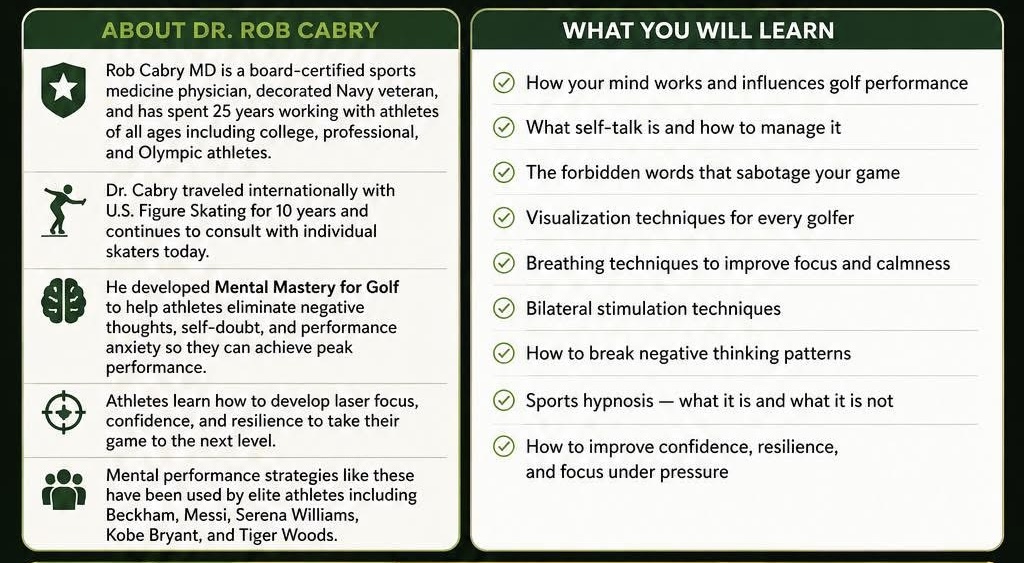
At Elite Mental Toughness, I help golfers strengthen their mental game using hypnosis and mental performance techniques designed to support confidence, concentration, and composure under pressure.
Whether you’re struggling with overthinking, first-tee nerves, self-doubt, or difficulty taking your driving-range performance onto the golf course, mental training may help you perform more consistently.
You don’t always need to change your swing. Sometimes, you need to change the way you think about your swing.
Train your mind. Trust your swing. Play your best golf.
Contact Elite Mental Toughness to learn how golf performance hypnosis can help you develop a stronger mental game.